


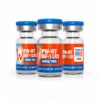
PW-RT 20mg Peptide
PW-RT 20mg Peptide. Our Retatrutide 20mg vial is a triple receptor agonist studied for its role in metabolism, appetite regulation, and body weight management. Developed by Eli Lilly, Retatrutide has become one of the most discussed compounds in obesity and metabolic research because it targets three separate hormone pathways involved in energy balance and nutrient regulation.
Unlike earlier compounds that focus on a single receptor, Retatrutide interacts with GLP-1, GIP, and glucagon receptors simultaneously. Researchers are particularly interested in how this combined mechanism may influence appetite signalling, energy expenditure, and metabolic adaptation over longer observation periods.
Its emergence has led to comparisons with compounds such as Wegovy and Mounjaro, particularly following published clinical trial data showing significant changes in body weight and metabolic markers.
What Is Retatrutide?
Retatrutide is a synthetic peptide designed to activate three hormone receptors associated with metabolism and energy regulation:
- GLP-1 (Glucagon-Like Peptide-1): Studied for its relationship with appetite control and gastric emptying.
- GIP (Glucose Dependent Insulinotropic Polypeptide): Investigated for its role in metabolic signalling and nutrient processing.
- Glucagon Receptors: Associated with energy expenditure and fat metabolism pathways.
This triple-agonist approach has made Retatrutide unique within metabolic research because it combines pathways that influence both energy intake and energy utilisation.
Researchers continue studying whether activating all three receptors together may create broader metabolic effects than single or dual receptor agonists.
The Benefits of Retrattitude From Research Settings
Research involving Retatrutide has explored several areas related to metabolism, appetite regulation, and body weight management.
Published studies have investigated:
- Changes in body weight over extended observation periods
- Reduced appetite and altered food-intake signalling
- Metabolic markers linked to blood glucose regulation
- Energy expenditure associated with glucagon receptor activation
- Long-term metabolic response across multiple hormone pathways
Researchers are particularly interested in how combining GLP-1, GIP, and glucagon receptor activity may influence broader metabolic systems compared with single-pathway compounds.
This research focuses on how appetite regulation, energy use, and metabolic signalling work together within the body.
As with similar receptor agonists, side effects continue to be evaluated through clinical trials. Reported observations have included nausea, diarrhoea, vomiting, and other gastrointestinal effects, most commonly during dose-escalation periods. These events were generally reported as mild to moderate in severity.
Use & Storage
Our Retatrutide 20mg vial is supplied as a dry peptide formulation intended for laboratory handling and analytical observation protocols.
Reconstitution should be carried out under standard laboratory conditions using validated preparation procedures suitable for assay and stability requirements.
Standard handling practices include:
- Maintaining stable refrigerated storage conditions
- Avoiding repeated freeze and thaw cycles
- Using consistent preparation and handling procedures
Following structured laboratory protocols helps support formulation stability and analytical consistency throughout observation periods.
Be the first to review “PW-RT 20mg Peptide”
Related products

GLP-1 PEPTIDES
GLP-1 PEPTIDES
GLP-1 PEPTIDES

GLP-1 PEPTIDES
GLP-1 PEPTIDES
GLP-1 PEPTIDES
GLP-1 PEPTIDES
GLP-1 PEPTIDES
Reviews
There are no reviews yet.